Doing It The Hard Way
 In the fifties or early sixties. A lot folks in my generation’s back to the land movement were vegetarians. I don’t see that in the off grid folks of today but there are likely some.
Many of today’s off grid folks are in places deliberately difficult to reach. Most back to the landers in the seventies went where they could find cheap land whether it was alongside a road like my house and barn or back in the boonies where my friends in the dome lived.
During the seventies, the rural Annapolis Valley were we shopped did not have supermarkets. It had small grocery stores and cooperatives where you could get your food, your baler twine, and some beef fattener for your steer. Beaver Fruit Cooperative got most of our business. I also did some bulk orders with the folks in the dome. We had a local hardware and a Sears catalogue store which is where we ordered our appliances.
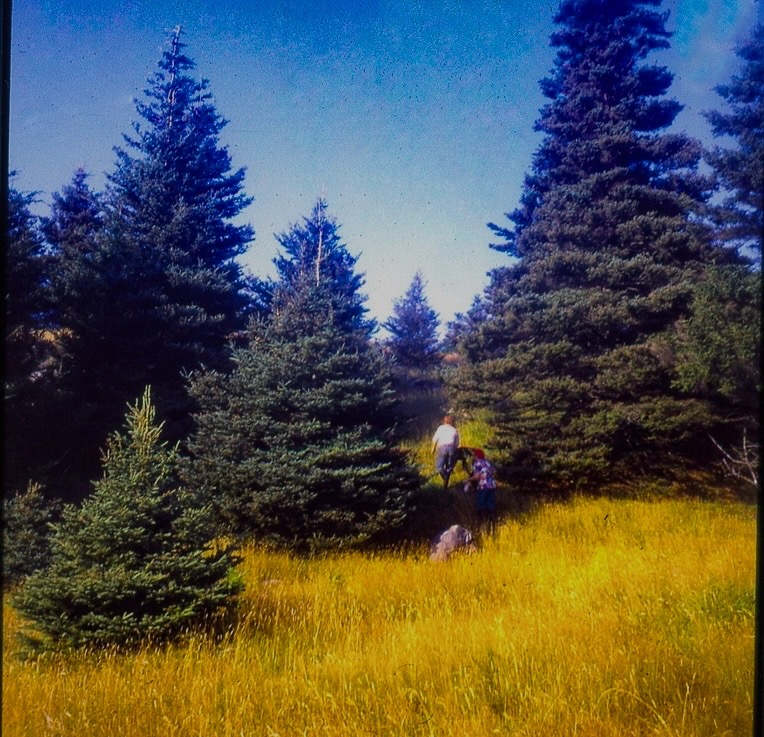
There were times in the early seventies when I though about getting farther from the roads that connected us to the rest of the world. Reality always intruded. I thought about homesteading in Newfoundland, but my wife took one look and said I would be homesteading alone. I even found a great spot on my land in Nova Scotia. It is pictured at the top of the post. It was over a mile off the road which does not sound very far until you factor in the heavy clay soil and the astronomical expense of building a mile long gravel road where gravel is in short supply. Then there would be getting power to the homestead. In those days there were no solar panels and battery systems to give you electricity off grid. Drilling water wells on our North Mountain was also problematic.
By the time we moved to New Brunswick we were well on the track for serious farming. We still gardened on a large scale, had chickens, and a milk cow. We do move to having someone butcher our annual steer for us instead of doing it ourselves. In creating our farm, we built well over a mile and a half of roads with New Brunswick’s ready supply of gravel over our rocky soils. I also convinced New Brunswick power to bring power a quarter of a mile back to the new barns that we built. We even drilled a well back by the barns. It provided so much water that it was hard to measure.
So by 1976, all the elements were in place for us to move farther from the village of Tay Creek. While we had not had a great experience with the people of St. Croix Cove, the people of Tay Creek had been so welcoming that neither my wife or I would consider it. It was also a great convenience to be by the road where the school bus picked up our children. It turned out we liked being part of our small farming village. We valued the connections of people dropping by to chat. I did not even mind cleaning the driveways of some residents who became close friends.
In the end it seems the biggest difference is that today’s off gridders is that they appear to be working to isolate themselves from others while the sixties and seventies back to landers were still interested in community. While I loved the small country stores, they are much more likely to seek out the anonymity of COSTCO. The money that some make from YouTube makes it even easier to not have ties with nearby communities. Obviously, there are exceptions and some off grid folks are more community oriented than others, but they are the exception rather than the rule.